


This week I’m experimenting with format. Above you’ll find an audio version of this newsletter. Going forward, newsletters in your email and in the substack app will have an audio version, read by the author. You may also listen to them in Apple Podcasts and Spotify under the podcast name Hearthfire Astrology. Please give me some grace in getting all this figured out. Audio versions may include parentheticals and musings not included in the written version, since written text is less friendly to asides than is the spoken word. For now, let’s just see what happens. As always, thank you for reading and/or listening.
*********
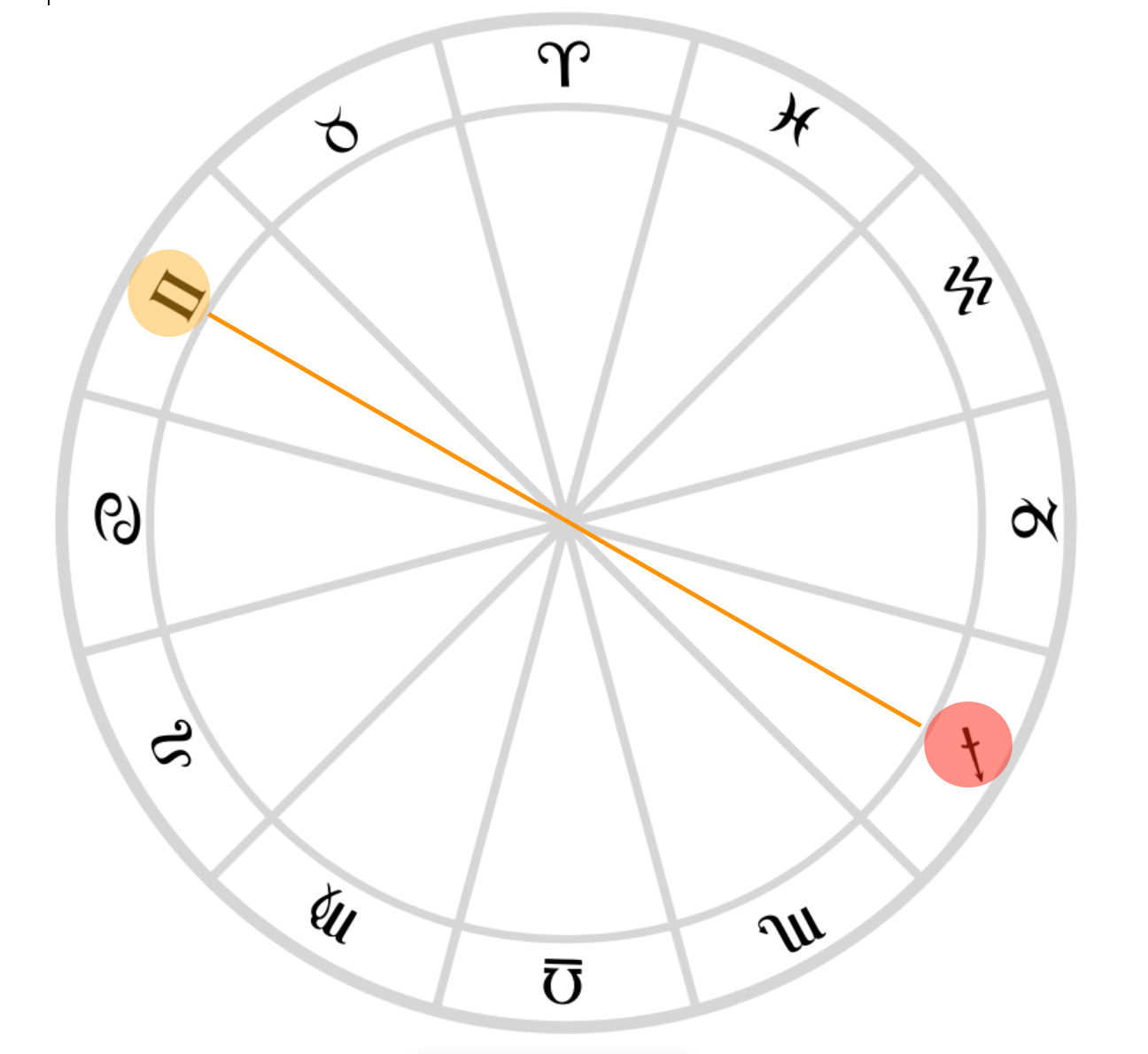
Welcome to the Sagittarius Full Moon! The Sun is still in Gemini while the Moon moves through the opposite sign of Sagittarius. My curiosity has been intense, as has my openness to possibility. I'm reading like mad, finding nuggets of wisdom scattered like seeds on the wind. Somehow, so much of it is exactly what I needed to confront. The universe is funny that way. The seemingly disparate pieces of life sometimes converge, allowing me to glimpse a coherent whole. Maybe I'm just feeling optimistic today or maybe some universal truth is coming through me in these pieces of writing.
I have to be optimistic because I recently made a big change. I'm leaving a job -- perhaps a whole profession -- I've worked for a long time (at least in Gemini time). I took early and easily to restaurants. Like me, a restaurant is a hearthfire: a place where all are welcome to gather and restore; a place to reconnect to our essential shared humanity. I've had hundreds of thousands of human interactions there. My worldview was forged there, an amalgam of every connection I've ever made (or failed to make). I understand what connection requires: each participants' capacity to hold different perspectives while remembering we are part of the same whole.
Hearthfire Astrology Newsletter is a reader-supported publication. To receive new posts and support my work, consider becoming a free or paid subscriber.
Gemini, an air sign ruled by Mercury, and Sagittarius, a fire sign ruled by Jupiter, both move energy from the center outward with great capacity. They need capacity to hold the variability of transition between darkness and light at the Solstices. Gemini is the sign of the intellect, curiosity, and information. Sagittarius is the sign of passion, belief, and storytelling. Gemini's neutrality can become ungrounded, as can Sagittarius's certainty.
Like Mars and Venus, Mercury and Jupiter are a pair. They form a multifaceted duality including small/big, trees/forest, parts/whole, curiosity/belief, and information/story. Like Mars and Venus, Mercury and Jupiter include each other. They mirror each other. Neither exists without the other -- but they are distinct, nonetheless. In fact, that's what's so interesting about dualities: they can be distinct while also containing one another.
Many people truly cannot tell the difference between themselves and everyone. They cannot tell the difference between their fractured piece of truth and the truth. People like that think anyone who disagrees is simply wrong (and sometimes also very bad). I confronted this often in hospitality. To oppose someone's piece of truth is deeply and pointlessly exhausting. Eventually, I learned a truth of my own: that both perspectives are true, despite any disagreement, yet I don't have to believe any of them. Most people don't engage both perspectives because it requires great capacity (servers have tremendous capacity). Many people think their perspectives must be affirmed externally in order to remain true so they seek affirmation rather aggressively, lest their whole worldview come tumbling down. After all, their worldview is based upon the validity of their own perspective relative to those of others. In my experience as a server, a shocking number of people behave as if this were true. I'm baffled by the lack of curiosity and also acknowledge the myriad incapacitating influences affecting people today.

The biggest incapacitating factor is the ubiquity of certain stories. This week, as I watch the stories about Los Angeles get packaged and sold as if humans were adversaries, I am reminded of my time in legal practice. My work there, as I understood it, was to tell a more compelling story than the opposing party. We are all working with the same set of laws. We were, quite often, working with the same set of facts. At the trial level, it was my job to weave the facts and the law together into stories compelling enough to make my clients' versions appear more true. That's how one wins in an adversarial legal system, and, according to the prevailing cultural story, winning is how you know you're a good person. There I learned another truth: the key to making a story seem true is the why.
The difference between information and story is the why. As I wrote at the Gemini New Moon two weeks ago, curiosity only needs information, not why that information should be believed as true. That's why an archive can contain unlimited information without ever posing a belief system in which that information is held. Once you add a why to some information it becomes a story. When you posit why something is a way, whether directly or indirectly, you force the audience to test that story against their own beliefs about why that thing is that way. In other words, you've held up a mirror to their beliefs
When the posited why comports with the audience's pre-existing why they are entertained and affirmed in their own perspectives. That's why superhero and princess stories are popular. Everyone wants to believe they are the hero who beats the villain or the princess who wins his heart and this story affirms that possibility. It also affirms the individualistic belief that everyone is (or can become) the hero or princess in their own story, keeping them striving against potential obstacles like awareness of perspective. Most have been primed since birth to accept these stories as versions of truths. The more an audience has been fed simplistic and overly broad whys, the more they will be inclined to believe as true any story in which that why is present. He is strong therefore he wins; she is pretty, therefore she wins. These cultural beliefs, planted by stories in which they are presented as truths, can become hardened in the personal beliefs of an unquestioning audience. Unquestioning audiences then emulate them in their own lives. That's how mirrors work; they only reflect back what is put in front of them.

That's why what we put in front of people matters. That's why stories should provoke questions, not give easy answers.
When a story gives a why that challenges the audience to question their own information, you see how enlarged their perspective can actually get. Do their beliefs allow them to replace existing information with new information? To modify it a little without completely discarding it? Can they entertain the possibility that a hero could be bad? Or that the ugly girl could win his heart? Have they been confronted enough and asked enough questions hitherto to consider that what they find weak or ugly might not be the absolute truth? If they do decide to expand their perspectives, are they themselves allowed to be strong or pretty even if they were once wrong about something?
Even more confronting, when an audience is given no why at all, they must piece it together themselves. Stories like this are considered fringe and generally relegated to the arthouse section where people who don't like to be confronted won't have to be confronted by their very existence. Even the most inquisitive audience sometimes struggles with these because story is such a huge part of how we see the world, and ourselves in it.

For someone to be willing to ask questions, they must also believe they are part of a whole from which they cannot be excommunicated for asking. Many belief systems do not pass this test, a sure indictaor that they are not wholes unto themselves. Wholes can contain questions. In fact, wholes can contain differences and perspectives of all sorts. That is made obvious by the fact that people disagree about the why of things all the time and yet existence continues. For people to handle total answerlessness, they really have to have a lot of capacity and a lot of faith that they don't have to produce true answers to exist.
There are belief systems that appear to do this. Astrology is one, though I question myself calling astrology a belief system. Whether people feel entertained and affirmed by it is another matter. I've heard it said that some belief systems see God in the smallest thing imaginable and some see God in the biggest thing imaginable. Both see God. God exists in both. And yet there's no clear evidence that God, if there is God, cares which you believe or even that you believe at all. It's both and neither and you'll never know which so you just have to allow others' perspectives and have faith that God loves all of us. Or don't. That's none of my business.
🪄🪄🪄🪄🪄🪄🪄🪄🪄
Want to support my work and continue to learn about how you can reorient into cyclic living? There are a few buttons below to choose from. Join me on the journey to liberation.


